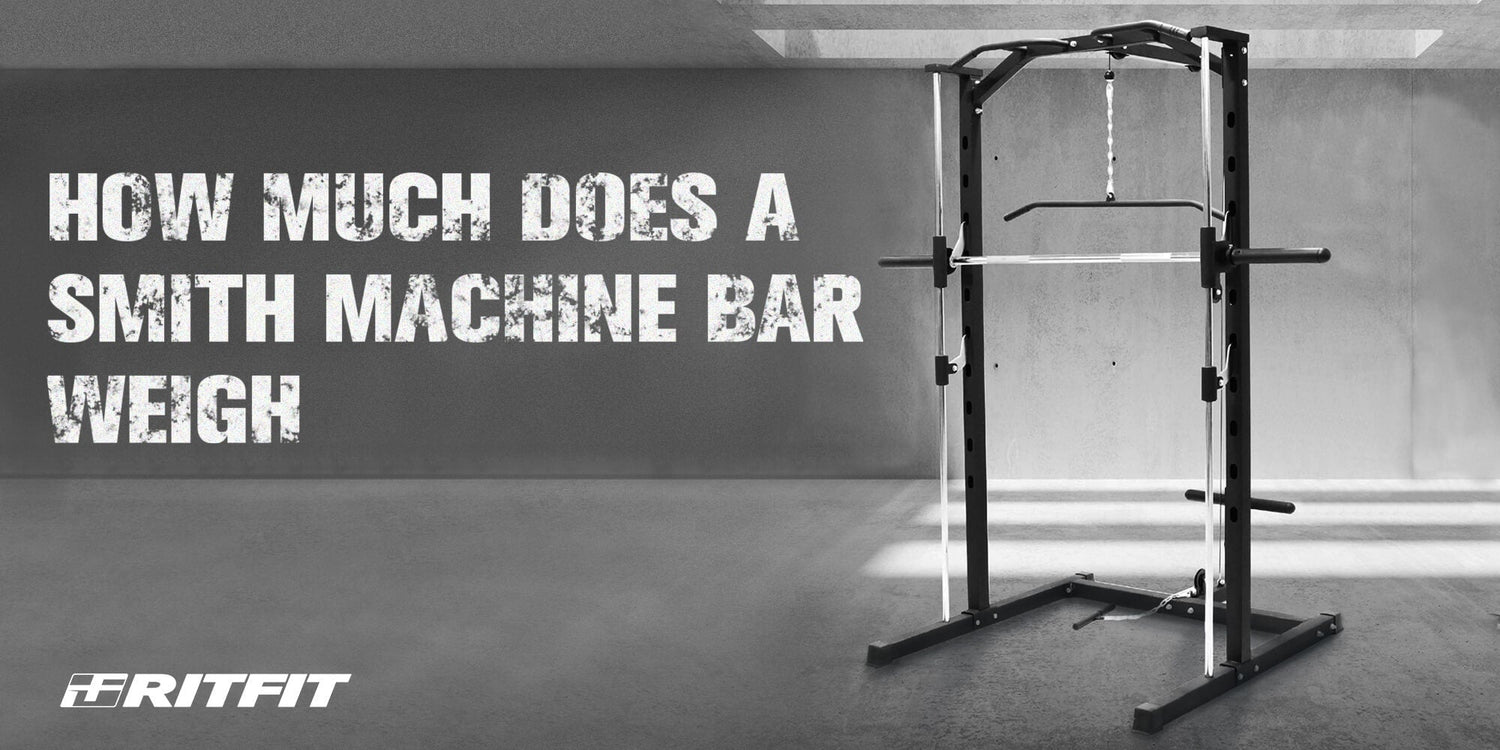
A Smith machine bar usually has an effective starting resistance of about 6 to 45 lb, but there is no universal standard. The real number depends on counterbalance design, rail friction, bar assembly, and whether the machine is built for a commercial gym or a home gym.
This guide explains bar mass, starting resistance, common weight ranges, measurement methods, and how to compare Smith machine numbers with an Olympic barbell. It also shows how to log your load more accurately for progressive overload.
Quick Answer:A Smith machine bar usually feels like about 6 to 45 lb of starting resistance, depending on the machine. Heavily counterbalanced commercial machines often feel light, while many home gym Smith machines feel closer to 25 to 35 lb. Measure your own unloaded bar for the most accurate training number.
Key Takeaways
- No universal standard: Smith machine bar weight changes by model, counterbalance system, and rail design.
- Starting resistance matters most: The number you feel at takeoff is more useful than the physical bar mass alone.
- Commercial machines often feel lighter: Counterbalanced systems can reduce the effective load at the start of the rep.
- Home gym machines often feel more direct: Many home systems feel closer to 25 to 35 lb because they use less counterbalance assistance.
- Measurement improves tracking: Once you measure your own machine, your training log and plate math become more consistent.
What Is a Smith Machine?
A Smith machine is a guided barbell system that moves along fixed rails. The fixed path reduces balance demands, which can help lifters focus on controlled pressing, squatting, lunging, rowing, and hip extension movements.
The key difference from free weights is that the machine guides the bar path. Research comparing Smith machine and free weight squat variations shows that stability can change force output and muscle activity, so Smith machine numbers should be treated as machine specific training data.[1]
Different Types of Smith Machines
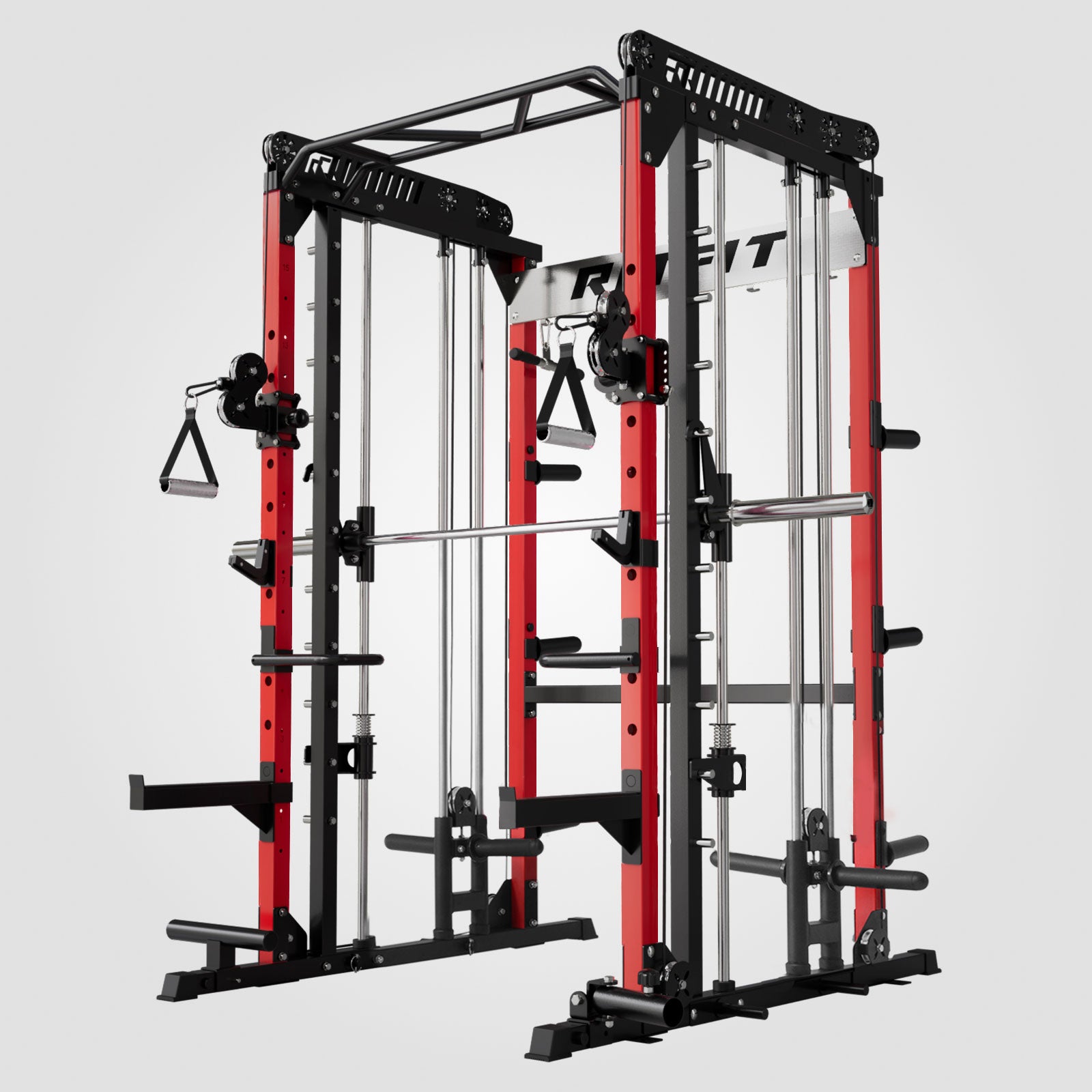
Smith machines feel different because bar design, guide rails, pulleys, bearings, and counterweights all change starting resistance. If you are comparing home options, the RitFit Smith machine collection is a useful place to review different frame and training formats.
Counterbalanced Smith Machines
Counterbalanced Smith machines use cables, pulleys, or internal counterweights to reduce the load you feel when the bar starts moving.

Linear Bearing Smith Machines
Linear bearing Smith machines use smoother guided travel and often feel more direct than heavily counterbalanced commercial units.

All in One Home Gym Smith Machines
All in one systems combine the Smith bar with rack functions, cable stations, and accessory options for broader home strength training.

Home gym example: The RitFit M1 Smith machine for home gym shows how a guided bar, rack station, and cable system can fit into one training setup.
Use the article method below to measure the exact starting resistance on your own machine before logging working weight.
Selectorized Smith Machines
Selectorized Smith machines connect resistance to a weight stack, so the load adjustment process is different from plate loaded Smith systems.

What Changes Smith Machine Bar Weight?
Smith machine bar weight changes because the lifter feels the entire machine system, not just the steel bar. Counterbalance, rail angle, guide friction, bearings, bar sleeves, and maintenance can all change the effective starting resistance.
Bar Mass vs. Starting Resistance
Bar mass is the physical weight of the bar, while starting resistance is the force needed to make the guided bar move from rest.
- Bar mass: The actual physical weight of the bar assembly.
- Starting resistance: The practical weight you feel when the unloaded bar starts moving.
- Training value: Starting resistance is the better number for workout logs because it changes the real load you lift.
Counterbalance Systems
A counterbalance lowers the bar’s effective starting weight, which is why some commercial machines feel much lighter than a 45 lb Olympic bar.
Rail Angle
A slight rail angle can change movement feel, but it does not reliably reveal the machine’s starting resistance.
Friction and Maintenance
Dirty guide rods, dry bearings, worn bushings, and uneven lubrication can make the same Smith machine feel heavier or less consistent across reps.
Why Knowing Smith Machine Bar Weight Matters
Knowing Smith machine bar weight helps you track total load, compare workouts, and avoid guessing your progress. It is especially useful when moving between commercial gyms, garage gyms, and free weight setups.
Progressive Overload
Progressive overload depends on consistent tracking, and research shows that both load progression and repetition progression can support muscular adaptations over time.[2]
Exercise Setup
Starting resistance changes how pressing, squatting, lunging, and rowing feel at the bottom of each rep.
- Bench work: Pairing a Smith machine with the RitFit Gator adjustable weight bench can support flat and incline pressing setups.
- Hybrid setups: A system like the RitFit Buffalo multifunctional Smith machine may feel different from a lightly counterbalanced commercial Smith station.
- Plate math: If you change machines, do not assume the same plates create the same working load.
Consistency Across Gyms
The same two plates per side can produce different total resistance on different Smith machines because the bar system itself is not standardized.
Common Smith Machine Bar Weight
Most Smith machine bars feel like about 6 to 45 lb of starting resistance. Commercial machines are often lighter because of counterbalance, while many home gym systems feel closer to a truer bar load.
| Machine Type | Typical Starting Resistance | What It Usually Feels Like |
|---|---|---|
| Heavily counterbalanced commercial unit | About 6 to 15 lb | Very light at takeoff and beginner friendly |
| Moderately counterbalanced commercial unit | About 15 to 25 lb | Controlled and lighter than a free bar |
| Home gym or non counterbalanced machine | About 25 to 35 lb | More direct and closer to a true bar feel |
| Heavy hybrid combo unit | Can approach 45 lb | More substantial takeoff load for stronger lifters |
Use these ranges as practical estimates, not universal specifications. Always check your manual or measure your own unloaded bar.
Quick Reality Check
If the Smith machine has a label, manual, or product page stating unloaded starting resistance, use that number first.
- Commercial gym feel: Often lighter than expected because the bar is counterbalanced.
- Home gym feel: Often heavier and more direct because there is less mechanical assistance.
- Related guide: Read does a Smith machine take off weight for a deeper explanation of counterbalance and effective load.
How to Calculate Total Smith Machine Weight
Total Smith machine weight equals the machine’s effective starting resistance plus all plates loaded on both sides. If the bar starts at 25 lb and you add one 45 lb plate per side, the total working load is about 115 lb.
| Example Setup | Calculation | Total Working Load |
|---|---|---|
| 15 lb starting resistance plus two 25 lb plates | 15 plus 25 plus 25 | 65 lb |
| 25 lb starting resistance plus two 45 lb plates | 25 plus 45 plus 45 | 115 lb |
| 35 lb starting resistance plus four 45 lb plates | 35 plus 45 plus 45 plus 45 plus 45 | 215 lb |
If you are comparing barbell numbers, remember that a standard full size Olympic bar is commonly treated as 45 lb in gym programming. For more context, read RitFit’s guide on how much an Olympic bar weighs or compare with a 7 ft Olympic barbell.
How to Measure a Smith Machine Bar Weight
You can measure Smith machine starting resistance with a floor scale, hanging scale, or controlled balance method. The goal is not laboratory precision, but a repeatable number you can use in your workout log.
Method 1: Floor Scale
A floor scale is the simplest method when the Smith bar can be lowered safely onto the scale or measured through bodyweight subtraction.
- Option A: Weigh yourself first, then step on the scale with the unloaded Smith bar resting on your shoulders, and subtract your bodyweight.
- Option B: Raise the scale on a stable box so the unloaded bar can rest directly on it at a natural bar height.
- Accuracy tip: Take two or three readings and average the result.
Method 2: Hanging Scale
A hanging scale can isolate the bar more directly if the strap is centered and the bar is fully supported during measurement.
- Center the strap: Place the strap around the middle of the bar to reduce side bias.
- Unload everything: Remove plates, collars, and attachments before testing.
- Record the stable number: Use the reading after the bar settles.
Method 3: Plate Balance Estimate
A rope and plate balance setup can provide a rough estimate, but it should only be used when the setup is stable and controlled.
- Create a balance point: Secure a rope to the bar and route it over a stable top support.
- Add plates gradually: Increase the opposite side until the bar stops rising or dropping.
- Use caution: Keep hands clear of pinch points and stop if the setup shifts.
Measurement Safety Tips
Measure only an unloaded Smith bar, use the safety hooks, keep your hands away from the rails, and ask another adult to help if the bar path or scale position feels unstable.
Smith Machine Bar vs. Olympic Barbell
A Smith machine bar and an Olympic barbell should not be treated as identical training tools. A Smith machine uses a fixed path and machine specific starting resistance, while a free bar requires more lifter controlled stabilization.
Key Differences
Machine based and free weight training can both build strength, but research suggests strength improvements are often most specific to the training mode being tested.[3]
- Smith machine: Fixed path, lower balance demand, machine specific starting resistance.
- Olympic barbell: Free path, higher stabilization demand, more direct transfer to traditional barbell lifting.
- Programming reality: Similar plate numbers do not always mean similar training stress.
How to Compare Smith and Free Weight Numbers
Compare Smith machine and free weight performance by matching exercise type, reps, range of motion, and effort level before comparing load.
- Match the movement: Compare squat to squat or bench press to bench press.
- Match the effort: Use the same rep target and similar difficulty level.
- Track your own ratio: Your personal Smith to free weight gap is more useful than a generic conversion formula.
Smith machine squats and leg press movements can also differ in quadriceps activation and perceived effort, so load comparisons should stay exercise specific.[4] For broader equipment context, compare Smith machine vs power rack and weight plates loaded vs weight stack Smith machines.
What Should Lifters Do With This Number?
Lifters should use Smith machine starting resistance as a tracking reference, not as a reason to chase ego numbers. Loading recommendations for strength, hypertrophy, and endurance depend on the training goal, exercise selection, effort, and progression plan.[5]
- For beginners: Learn the machine path first, then add load gradually.
- For hypertrophy: Track reps, effort, and controlled range of motion alongside load.
- For strength: Keep your Smith machine records separate from free barbell records.
- For home gyms: Measure your own setup once, then use that number consistently.
FAQs About Smith Machine Bar Weight
How much does a Smith machine bar weigh?
A Smith machine bar usually feels like about 6 to 45 lb of starting resistance. Commercial counterbalanced machines often feel lighter, while many home gym systems feel closer to 25 to 35 lb. The most accurate number is the unloaded starting resistance of your own machine.
What is Smith machine starting resistance?
Smith machine starting resistance is the force needed to move the unloaded bar from rest. It matters more than physical bar mass because counterweights, rails, bearings, and friction change what the lifter actually feels. Use this number when logging total working weight.
Is a Smith machine bar always 45 pounds?
No. A Smith machine bar is not always 45 pounds. Some heavy hybrid units may approach that feel, but many commercial machines feel much lighter because of counterbalance systems. Always check the machine label, product manual, or measure the unloaded bar yourself.
How do you calculate total weight on a Smith machine?
Total Smith machine weight equals starting resistance plus all plates loaded on both sides. If the bar starts at 25 lb and you add one 45 lb plate on each side, your working load is about 115 lb. Keep that formula consistent in your training log.
Does a counterbalanced Smith machine feel lighter?
Yes. A counterbalanced Smith machine usually feels lighter because cables, pulleys, or internal counterweights offset part of the bar load. This is why some commercial Smith machines feel much easier at takeoff than a standard free weight Olympic barbell.
Can you compare Smith machine weight to free weights?
Yes. You can compare Smith machine weight to free weights, but the comparison is not one to one. Match the same exercise, reps, range of motion, and effort level first. Then track your own pattern instead of relying on a universal conversion formula.
Should beginners count the Smith machine bar weight?
Yes. Beginners should count Smith machine bar weight because it affects total training load. The number does not need to be perfect on day one, but using a consistent starting resistance helps track progress, avoid sudden jumps, and compare workouts more honestly.
How do you measure Smith machine bar weight safely?
Measure Smith machine bar weight with the bar unloaded, hooks secured, and a stable scale setup. Use a floor scale, hanging scale, or controlled balance method. Take several readings and average them. Stop immediately if the bar shifts or the setup feels unstable.
Conclusion
Smith machine bar weight is best understood as starting resistance, not just the physical bar mass. Most machines feel like about 6 to 45 lb before plates are added, but your own machine is the only number that truly matters for accurate logging. Measure it once, record it, and keep Smith machine progress separate from free barbell progress. Explore RitFit Smith machine options if you want a home gym setup built around guided strength training.
Disclaimer
This article is for general educational purposes only and does not replace your equipment manual, professional coaching, or medical advice. Always follow your machine’s safety instructions, load limits, and setup guidance, and stop any exercise that causes sharp pain, dizziness, numbness, or loss of control.
References
1. van den Tillaar R, Larsen S. Kinematic and EMG comparison between variations of unilateral squats under different stabilities. Sports Med Int Open. 2020;4:E59-E66. doi:10.1055/a-1195-1039. https://pmc.ncbi.nlm.nih.gov/articles/PMC7365712/
2. Plotkin D, Coleman M, Van Every D, Maldonado J, Oberlin D, Israetel M, Feather J, Alto A, Vigotsky AD, Schoenfeld BJ. Progressive overload without progressing load? The effects of load or repetition progression on muscular adaptations. PeerJ. 2022;10:e14142. doi:10.7717/peerj.14142. https://pmc.ncbi.nlm.nih.gov/articles/PMC9528903/
3. Haugen ME, Vårvik FT, Larsen S, Haugen AS, van den Tillaar R, Bjørnsen T. Effect of free-weight vs. machine-based strength training on maximal strength, hypertrophy and jump performance: a systematic review and meta-analysis. BMC Sports Sci Med Rehabil. 2023;15:103. doi:10.1186/s13102-023-00713-4. https://pmc.ncbi.nlm.nih.gov/articles/PMC10426227/
4. Migliaccio GM, Dello Iacono A, Ardigò LP, Samozino P, Iuliano E, Grgantov Z, Padulo J. Leg press vs. Smith machine: quadriceps activation and overall perceived effort profiles. Front Physiol. 2018;9:1481. doi:10.3389/fphys.2018.01481. https://pmc.ncbi.nlm.nih.gov/articles/PMC6206431/
5. Schoenfeld BJ, Grgic J, Van Every DW, Plotkin DL. Loading recommendations for muscle strength, hypertrophy, and local endurance: a re-examination of the repetition continuum. Sports. 2021;9(2):32. doi:10.3390/sports9020032. https://pmc.ncbi.nlm.nih.gov/articles/PMC7927075/